Showing posts with label Asian Australian Artist. Show all posts

Thursday, 11 February 2021

Jayanto Tan

07 February - 06 March      Mantra, I'm a ghost in my own home


Jayanto Tan’s installation, Mantra, I’m a ghost in my own home is SLOT's offering in celebration of Chinese New Year.

For Jayanto New Year is an opportunity for celebration. Indeed the Chinese character, Double Happiness that is both the subject and form of his installation is a celebration of marriage. In this case, perhaps it articulates remnant marriages and marriages yet to be forged between Jayanto and his many homes.

Jayanto is Chinese, although he was born in Indonesia, which casts him as a part of many sub-groups including the Peranakan culture. That is the culture of Chinese immigrants who assimilated the Malay culture and in the process established a uniquely hybrid culture expressed in dress, cuisine and architecture. Now Jayanto is also an Australian, a condition that he has wittily summarised with the invention of the Pandan Lamington, pandan being a Malay food additive that turns everything an optimistic green color. Here in the wide brown land a green lamington offers double happiness for sure. One can be found on the left in Jayanto’s finely sculptured ceramic, albeit rendered in monochromatic white.


Here it has been married with other delicacies into a wreath, a European symbol that simultaneously celebrates birth and death as the unity of eternal life.

In response, the Mantra, I'm a ghost in my own home has been deeply considered. As Jayanto observes “the thousands text of ‘Double Happiness’ could read as my mantra for future happiness…Perhaps there is no future!”


Tony Twigg


Saturday, 4 July 2020

Lisa Pang

28 June - 25 July   CROSSING 2020

Link to artist's website


Lisa Pang (Lisa Sharp)’s work Crossing 2020 is an intersection. She describes it as being “emblematic of journeys we take, back and forth between places and positions.” It’s a meditation on hiatus and diversion at the behest of the unexpected, the accidental, and the unintended, which right now is Covid19. It’s also an exclamation mark sitting, with remarkable resonance where polarities leach into each other. 


Resonant of what you ask? And of course life is the answer. Covid19 intervened, isolating Lisa in Sydney with her children and husband, Jon, the Sharp part of her name. Her arrival here from Tokyo in March for a show at STACKS projects was but a single event in a life of labyrinthine crossings that began in Jesselton the capital of the British Crown Colony of North Borneo at about the time it became Kota Kinabalu the capital of the Malaysian state, Sabah. Lisa’s father, the Pang part of her name, had arrived there from China when the British North Borneo Company ruled it. He travelled on to Australia under the Colombo Plan to study Architecture at Sydney University and returned with an 8th generation first fleeter, Lisa’s mum, Janis in 1966. At 12 Lisa was delivered to Australia as a boarding school student - the antithesis of indigenous - the product of layer upon layer of “journeys” stretching across the era of colonisation that in Northern Borneo dates back to the Castillie War of 1571, half a millennium ago. 

Three decades later Lisa was a lawyer, married with two children thinking about art. She graduated from N.A.S. in 2016 and changed her name; she says, to Lisa Pang on the 1st of January 2020, not out of frustration with parenthood or marriage but in acknowledgement of something that had surfaced in her art while living in Japan - a leaching of one layer into another by way of a Crossing? 

It’s tempting to consider that as Lisa’s birth roughly coincided with the end of the colonial era, her work Crossing 2020 roughly coincides with the end of the paper era. Across millennia the paper scrolls of China coincide with the New York Times reporting the Covid19 crisis at the moment when paper makes way for the digital scribe. When the swipe of a credit card replaces the reverently tendered bank note. Her emphatic punctuation mark resonates with change that is as permanent as the leaves on the plane trees across the road. It marks the end and it marks the beginning.


-Tony Twigg


My practice centres on materiality and processes, which provide both the forum and the form for engaging with the visual imagery of geometric abstraction. 

This work, The Crossing is an ink on paper installation of two scrolls, placed horizontally and vertically to form a cross. It reflects on a crossing as emblematic of the journeys we take, as we go back and forth between places and positions. Paper, as a material is fundamental to the sharing of ideas and information and can take on many forms. It can be anything from a single written character to globally disseminated newspaper publications. It is ink on paper, black on white, enduring and ephemeral at the same time. While elemental, the symbol of the cross is heavy with connotations from the histories of abstraction and of spirituality. Presented here as fractured imagery, small squares torn from newspapers, it is an invitation to think about human communication and the material, visual means it manifests. 


Biography:

Lisa is a Malaysian-born Australian artist currently based in Sydney and Tokyo. She works across painting, drawing, installation and performance. With an interest in materiality as a source of meaning, her work incorporates everyday things and references daily rituals in an exploration of their metaphorical potential in visual art. 


Lisa Pang
June 2020


Monday, 12 February 2018

Pamela Leung

link to artist's website

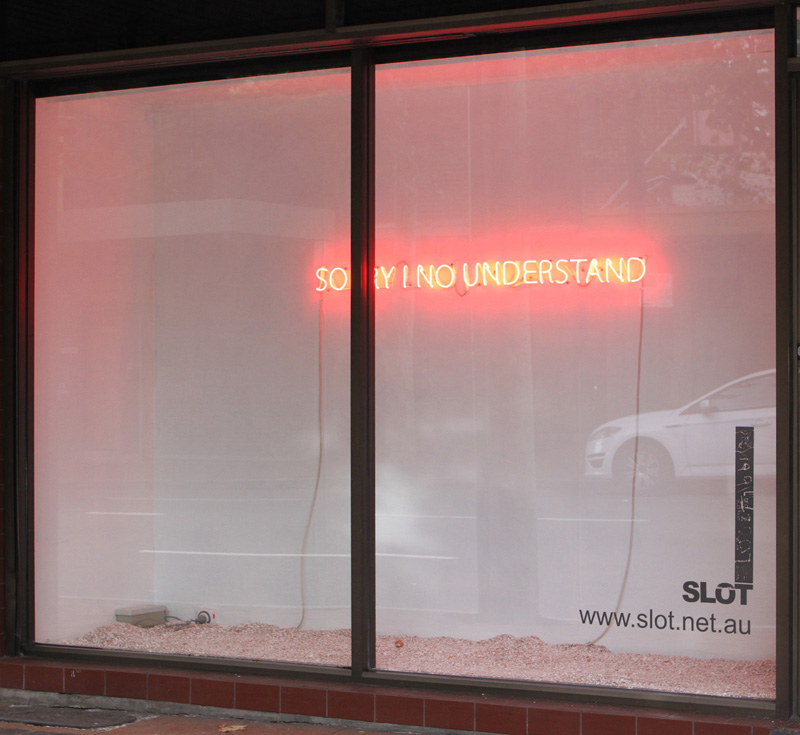
10 February - 11 March       Sorry I No Understand


Pamela Leung. Sorry I No Understand, 2018. Neon light with broken egg shells


Pamela Leung. Sorry I No Understand, 2018. Neon light with broken egg shells


Pamela Leung’s artworks draw on the idea of hope, which is integral to the migratory experience. Hope underpins relationships and customs, which are profoundly affected by displacement and diaspora. Leung’s found materials and everyday objects, epitomize the routines of daily life, while their functionality provides a symbolic reading for the sculpture and installations –  in which red and white connect to the cultural, spiritual, Zen, meditation, memories and emotions.

SORRY I NO UNDERSTAND is a new work using text to reflect on the experience of dislocation, and the humanity within social justice. The line of the title has been said thousands of times whenever there have been immigrants. But how often has it been neither heard nor understood?

Sorry I don’t understand this country.
Sorry I don’t understand the culture.
Sorry I don’t understand the language.
Sorry I don’t understand the people.
Sorry I don’t have a choice.
Sorry I have to escape.
Sorry I need to live.
Sorry I need to survive.
Sorry please listen to me instead of yelling.
Sorry please be patient with me instead of annoyed.
Sorry please give me a smile instead of anger.
Sorry please share some empathy instead of pity.


Pamela Leung


Pamela Leung. Sorry I No Understand, 2018. Neon light with egg shells.
Pamela was born in Hong Kong with the desire to be an artist.  She became a window dresser, when as an adult she left home with a 3 month Australian tourist visa Australia in her pocket. Here she became a wife, a mother, a businesswoman, and a hard worker, then, about a decade ago she turned her back on home for a second time with nothing more than the desire to make art in her pocket.

Education, the Australian key to change began at TAFE for Pamela. A one-year Diploma in Art became an undergraduate course in sculpture at the National Art School then an honors year in drawing and finally a master’s degree in painting. It was an education in Australia that has given us this, art works that Pamela flatly states, “draw on the idea of hope”.  It is of course the migrant’s vision. It’s a glorious one that is tempered by dislocation, social injustice and the plea, “sorry I no understand”.

Pamela asks, “the title has been said thousands of times but how often has it been heard or understood?” When I read it I can’t help recalling Pauline Hanson’s infamous retort, “please explain”.  Explanation and understanding don’t often include empathy. Empathy is something we leave to artists who, however educated in our societies manners have the need to be heard, in this case gloriously so in neon above a carpet of trampled eggshells. This is a work of innuendo read in material and metaphoric terms that propose tolerance, not of anything in particular but as an act of faith.

Tony Twigg


Sorry I No Understand on 38 Botany Road, Alexandria