Showing posts with label sculptures. Show all posts

Saturday, 26 February 2022

Tracy Luff

20 February - 26 March      Passing Through    


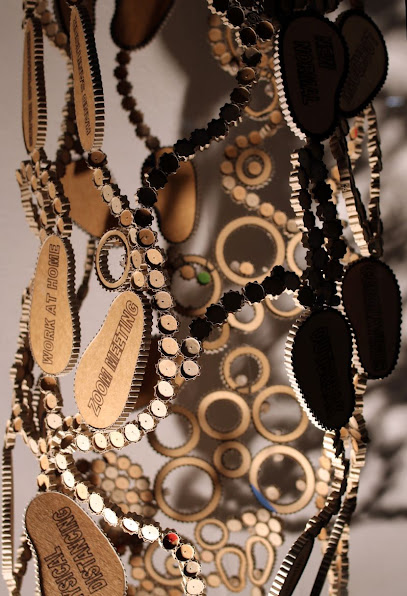
The first thing that Tracy Luff said to me about her work, Passing Through was that it had “ totally changed direction from what it was going to be ” Then after spending 5 days in my studio working on the piece as a flat object she spent another day turning it into the cylinder that is displayed in SLOT. 


Perhaps unintentionally she has illustrated one of the truisms of art making – that art lies in the making of an object not the preconceptions brought to its inception. Art is an inquiry. An inquiry into the self, into the materials that the work is made of, into events that shape our thinking, but above all it is 
simply an inquiry into our thinking. And in this case the artist, Tracy Luff was thinking about Covid 19.

It’s hard to escape the buzzwords of Covid neatly printed on shapes that are woven into the fabric of thepiece. In Tracy’s eyes they introduce an idea of domestic life. They alert the work as our lives have been alerted to the need for vigilance against the threat of Covid. And they are in the shape of feet because Covid has come and will go. In Tracy’s reckoning it will disappear. She continues – “ the piece is for fun, playing with the words and how they match up but they are serious words – the fun didn’t continue and it gets more serious – every action connects with what is happening ”

Watching Tracy’s daily work offered an insight into her art making. The fun of the Covid buzzwords was forgotten as thoughtfully connecting forms and voids, articulated in threaded cardboard discs replaced them as the subject of the work. Irrespective of any tangible meaning that may be attached to the work it is as Tracy commented “ the process of making the work leads to the form it takes ” and further “ the form is dictated by what the material can and can’t do ” Or as the mid 20th century Canadian philosopher Marshall McLuhan put it  – “ the medium is the message.” 

And it could be that the reasoned beauty of Tracy’s artwork supplants any message it may carry about the presence or absence of Covid 19 in our community or thinking.

Tony Twigg


Saturday, 1 August 2020

Anya Pesce

27 July - 29 August      Rupture

Link to artist's website


Anya Pesce says her art-work, Rupture,  evokes “the uncertainty and futility we are experiencing during the Covid 19 epidemic.”

She also explains its making process in detail. Since 2015, Rudi, who owns a plastic fabrication shop in Fairfield has welcomed Anya into his factory where she uses a machine that extrudes plexiglas, on this occasion beyond its limit. When the bubble burst, in a single uncontrolled action, the brittle sheet of plexiglas became flesh, with flaying lips, enticingly enclosing an orifice. It’s sexy. Like a sports car, a cocktail bar after dark and all the shiny advertising that preys on the biology of our brains, her art is visceral, with desirability that invites a new category – Pop Abstraction.

In conversation, Anya takes this idea further by describing the way her long education in art, at Meadow Bank TAFE, Charlie Sheard Studio School and the National Art School lead her from painting through installation art to the idea of making as opposed to fabricating, works in a single gestural action. And in that sense this work, Rupture would be the epitome of Anya’s work to date.

Reconciling the idea of spontaneous sexualized exuberance with Covid 19, is of course impossible, they preclude each other. But a meditation on it throws up questions about the nature of content in art-works: The content of a novel for example has little to do with the beauty of the printed page, however appealing it might be. In contrast the content of an abstract painting does not extend beyond an appreciation of its component parts however enticing it might be to impose symbolism on it. Needless to say it is difficult to read any art-work out side of the context of its making, its time and its culture, which unquestionably includes Covid19 at the moment.

-Tony Twigg


Rupture stands as a metaphor for the uncertainty and futility we are experiencing during this COVID-19 pandemic. When words are limited, emotions challenged and uncertainty prevails, a visual expression can instantly evoke a visceral response.

As an artist I obsessively search for new ideas, reimagining forms, shapes and colours to reinvent my work, while consistently using the same material, polymethyl methacrylate - acrylic.

During this COVID-19 pandemic, I embraced the stillness imposed on me during self-isolation, and was able to reflect on my existing practice to take the opportunity and experiment with new ideas and techniques.

To date my works have been made by my hand, manipulating the material with a predictable outcome. Rupture is the outcome of a shift in my practice which involves the use of machinery to determine the work.

In this technique, the material is heated and vacuum-suctioned via a template, which is simultaneously inflated and deflated with air, altering the surface. Mimicking breath, the material is challenged to the point of explosion, resulting in the work’s fractured surface.

Rupture resembles an open wound. In stark contrast to the forms typical of my practice, which are made with an impeccable surface. Here, a gaping hole exists, framed by shards of plastic that burst forward into the viewer’s space.

A tension exists due to the randomness of the fractured material framed by the external geometrical border.

-Anya Pesce


Wednesday, 25 July 2018

Mark Dubner

22 July - 25 August      Progeny


Link to artist's website


Mark Dubner lists his teachers as Bob Boynes, Merilyn Fairskye, Ruth Waller and Mandy Martin. He was a student at the Canberra School of Art where he studied painting. After art school he put an economics degree he had picked up at uni to good use in a job at the Bureau of Statistics in Canberra. The job as a statistician lasted about 30 years. But he said he always maintained a studio, as a shrine to the idea of being an artist, perhaps, or as a locus of reflection, simultaneously physical and metaphysical?

Now Mark’s time is split between projects in the Solomon Islands and Timor arranged by the Australian Government as foreign aid, short courses at the National Art School where he studies metal sculpture and a studio at Addison Road in Marrickville, which is where Progeny came into being.

Progeny is a “respite from intuition” for Mark. Progeny he said is something more deliberate. A considered meditation that responds to the window space of SLOT and some of the 15 or so ideas the window threw up for him. He wanted something that was an illusion not an explanation of a fatalistic idea. He came up with lumps of clay that are like the stuff people are made from. “It’s fatalistic, all those heads present different pathways that end up in the same place.”

It’s pointless of course to ask an artist what their work is about. Their considered response to that question is staring you in the face. It is the work itself. Here a meditation on destiny and desire that encapsulates the kinds of lives lived around here these days. A life that has a beginning and an end lived across a passage of lives that reaches beyond any particular beginning or end.

Progeny proposes a question for me – is it fatalistic that our lives turn out pretty much like most other people‘s lives or is it that we are all living pretty much the same life? Either way, Mark's cypher, the traced outline of his partner walks lightly through this landscape of lives lived.

Tony Twigg


Sunday, 21 January 2018

Ana Pollak

link to artist's website

12 January - 10 February       Towers


Ana’s farther and her grandparents came to Australia as refugees from Europe. Ana herself has lived for the last 30 years, since 1987 in a house she built with her partner David on Dangar Island, about an hour and a half north of Sydney in the Hawkesbury River. Ana is no stranger to the Australian landscape where these towers began to form in her imagination.


They are an idea she carried with her to Hong Kong, another island where the verticality of the eucalypt gives way to the built environment, literally towers.  Hong Kong offers the unique urban experience of encountering multi story buildings at the middle level. As with Ana’s towers, buildings are appreciated without reference to the top or bottom. The towers of Dangar and the buildings of Hong Kong are each a set of pragmatic structures that pulsate with rhythms without reference to the narrative constraints of a beginning or end.
 
In Hong Kong as a guest of the Nock Art Foundation to study calligraphy, as she described “people embraced me in the brotherhood of the line.” Ana makes drawings.  Impressively she won the celebrated Dobell Drawing Prize in 2007, and before all else, these towers are drawings made with lines collected “outside the front door” on Dangar Island.

Looking at Ana’s towers I found myself reflecting on the bamboo scaffolding used on the building sites of South East Asian cities. Structures Ana said she had marveled at in Hong Kong where they are tightly wrapped in a fabric covering hinting at “the bones” beneath the “skin”. All these enigmatic structures have something in common. It is that a person made the decision on the spot, about how to fit one bit into another, about which bit of material was best suited to bridge a particular gap. Here a person has solved a problem and it’s that solution that becomes art because it carries with it someone’s humanity. Birds, animals even insects make comparable structures that in fairness have an equal claim as ART. Their work points to the universality of Ana’s expression. It reaches from the devastation of war-torn Europe across the Australian isle to our Asian future, “the brotherhood of line” indeed.

Back in Australia and after 6 weeks in her studio Ana’s work is offered as art, prompting the questions. What do you seen in your imagery? Her response, “pass”. What is your process? – “pass”. How do you begin? – “pass”. And how do you conclude? “That’s the tricky thing that everyone’s having a problem with, when the tower falls over, when it gets too tall for the studio”. Apparently this is a liner experience without beginning or end.

- Tony Twigg

Saturday, 26 August 2017

Alfredo Aquilizan & Isabel Gaudinez-Aquilizan

 20 August - 16 September      Passage, Another Country, 2017


The art of the Filipino-Australian artists Alfredo and Isabel Aquilizan is a traveler's tale, be that of the immigrant or the nomad. They have considered what is left behind, what is carried with the travelers on their journey and they have mined their own families’ migration to Australia as the subject and the substance of their art. 

Alfredo & Isabel Aquilizan. Passage, Another Country, 2017. Cardboard construction with photographs of horizons.


They began working with their chosen medium, the travelers' discarded cardboard carton in a Sherman Contemporary Art Foundation project of 2012, “Inhabit another country”. This installation was an extrapolation of the homes built along the shoreline of Mindanao by the Bajau, the gypsies of the Sulu Sea. These encrustations are but one aspect of a broader architecture of poverty that has become a subject of Filipino Art and it imbued with an innate humanity. In recent museum scaled installations the Aquilizans have romanticized these necessities of habitation as boats, the travelers' vehicle and the nomads' home. 


The boat is an image with a deep resonance in Australian cultural psyche. From the armadas of convict ships in our mythic past to the fishing boats that ferried contemporary migrants euphemistically described as irregular maritime arrivals. Migration has defined Australia. The vast migrant ships assembled by the Aquilizans have also become an apparent destination in themselves, hinting at the darkest fate of the immigrant, a perpetual journey. 


The two shoe like walking boats exhibited here were made during the Aquilizans' recent residency at the Mosman Art Gallery that was part of the Bayanihan Philippine Art Project, a suite of exhibitions celebrating Filipino culture presented in various Sydney art galleries. And as in the Aqulizians' work, the Bayanihan Art Project addressed the migrants' central concerns of home, of be-longing and of utilitarian possessions reconfigured as cultural artifacts. 

- Tony Twigg, 2017

Sunday, 14 May 2017

Keiko Matsui

 7 May - 7 June      Scar Vessels


Directly stemming from my Japanese heritage and familiarity with the mending and restoring technique known as Kintsugi, my current work explores the altering and reforming of fine porcelain forms through the cutting and rejoining of sections. The Kintsugi itself celebrates the damage and subsequent visible mending that results from the use of important functional objects.


Handwoven fabrics are overtly repaired (with contrasting pieces covering tears and worn areas as patches) while broken ceramics are glued (with lacquer and gold powder used to make such repairs highly visible) a clear celebration of use, breakage and its mending. Such activities are in direct conflict to the rejection of wear and breakage so embedded in my adopted Western culture.
I enjoy working with fine porcelain. It is extremely sensitive and responsive to the human touch when it’s soft. When fired, it becomes translucent and very strong. The nature of clay is endlessly fascinating.

I make a symmetrical shape on the wheel or paper-thin soft slab from porcelain, and then alter the form by cutting and re-joining the parts.
When putting the parts together with liquid clay, excess clay pushes out of the joint and makes a line like a human scar. I am drawn to the idea of an organic detail juxtaposed with the consistent lines of the wheeled form. It is like finding imperfection in our everyday.
I seek simple beauty in my work. 

Keiko Matsui 0425-725- 978
Email: info@keikomatsui.com.au


Keiko Matsui

Keiko Matsui's installation of Scar Vessels series consists mostly of the porcelain pieces made in 2014 with the more recent chair series.  These pieces are minimal in form.  The variations that create their individuality are mostly in the way the porcelain sheets are folded and joined.  They enclose the space they inhabit and turned to vessels to contain.   How these porcelain sheets meet dictate the forms they take.  Inspired by the art of Kintsugi, the junctures are left with their 'mending' traces.  Having them as an integral part of the identity of these forms, their appearance suggests bodies with healed scars.

Keiko MatsuiThe configuration of the familiar shapes found in the homes of the everyday conjures up intimate domestic setting.  The use of scale in the ceramic chair with the 'real' chair provides a poetic narrative on the relationships amongst the assembled pieces. 

This reminds me of Robert Therrien's use of unusual scale in his re-creation of everyday objects as sculptures to strip the visual cue of their assigned functions. They are instead used as personal symbols to regenerate an emotional space of a childhood memory.  This is echoed in Keiko's installation.

In this installation beauty is sought in the making, mending and in the arrangement. The creation of beauty in this space is controlled.  It is driven by the process of working with the intrinsic nature of the materials and an 'innate knowing' that has passed down through the generation

Anie Nheu


Sunday, 13 November 2016

Charles Cooper & Pia Larsen


6 November - 10 December      Flag Wavering


Pia Larsen and Charles Cooper have assembled an exhibition of nine Sydney artists meditating on the national symbol of the U.S.A and what underlies the American Project at the moment of that country’s cyclic rebirth, the Presidential election. 


Pia Larsen. Welcome & Last Drinks.  

Paper, bottles, gouache, digital prints, 

watercolour & ink. Dimensions variable

Below: Charles Cooper. Old Glory. Watercolour 

on paper. 18 x 26cm


Assemblage of Flag Wavering.


Charles Cooper. Old Glory. Watercolour on paper. 18 x 26cm 

Pia Larsen. Welcome & Last Drinks. Paper, bottles, gouache, digital prints, watercolour & ink. Dimensions variable

Margaret Roberts. 50 black stars and half a Strzeminski painting. Tulle + floor tape. 75 x 35cm


Nicole Ellis 

Faded and Down Home 1 & 2

Cotton on wood

loose cotton pieces. 

241cm x 2.5cm


Left: Frank Littler. Flags of perpetual war 1, 2 & 3. Oil paint on canvas paper. 30 x 42cm & 28 x 36cm.  Right: Lynne Eastaway. Fold. Acrylic paint on Belgian linen. 13 x 18 x 8cm.


Wendy Murray. GIANTS & DODGERS (& I’m not talking sport). Acrylic monoprint (serigraph) from letterpress positive set at Hamilton Ink Spot. 76 x 51cm/ installation variable


Tony Twigg. Stars & Stripes. 

 Enamel paint on timber construction

found objects. 195 x 31 x 12cm


Maryanne Coutts. Black News/White News: Stars & Stripes. Watercolour + gouache on paper. 31 x 31cm.  

Pia Larsen's bottles on the lower right