Showing posts with label Australian Artist. Show all posts

Friday, 17 February 2023

Slot Projects


SLOT ON THE ROCKS


Placemaking N.S.W. has commissioned SLOT to present a series of five windows under the title – Curated Windows - in the window of 23 Nurses Walk, The Rocks / Tallowoladah.

December 2022 – April 2023


Window No. 3


Celestial Rocks

Sandra Winkworth


Sandra Winkworth's work, Celestial Rocks, is a direct response to this place. During the haphazard early morning walks around The Rocks / Tallowoladah Sandra has gathered evidence of local domesticity, wildlife and of travellers of the day and of the night.  In her studio, your litter is fashioned into opalescent celebration of the vernacular.  It is the archaeology of now - of our being.


February 9 – March 8


Tuesday, 7 February 2023

Emidio Puglielli

Halves     5 February – 11 March

more on the artist


Halves by Emidio Puglielli


Emidio Puglielli’s work Halves is an examination of forgetting. It is an answer he says to the question, “what does forgetting look like”. And it’s a quest that began in his adult years with the discovery that he had forgotten the people and events of his childhood as recorded in a box of family photos. As much as prompting artmaking, that moment of pause proposed an academic inquiry. Begun at RMIT in Melbourne, because he needed to understand his making process, it has since become a PhD.

Halves by Emidio Puglielli

This quietly poetic work, Halves, speaks, without mediation, of a mood that defies articulation. It is simultaneously known and unknown, as Emidio says “the physical presence of an absence.” His art begins in anonymous photographs found in junk shops that have a single common quality- they were made in the late 1960’s and early 70’s, the years of Emidio’s childhood. They are scanned and reprinted before what we would immediately think of as the subject is surgically removed. Remarkably, rather than cancelling the mood of the photograph it seems to be amplified.  Assembled as a narrative that mood is maintained in a kind of cinematic panorama. In this language of images, mood is triggered by a multitude of known and lived experiences dominated by a nameless presence.

For Emidio this adult dance of half memory is a counterpoint to his adolescent years when as the child of Italian immigrants to Melbourne he yearned of forgetting. It would be an unburdening that would  permit  Emidio the outsider to take on the mantle of an Australian everyman.  


Halves by Emidio Puglielli


Halves by Emidio Puglielli


Returning to Italy as an adult he described the experience of many migrants who in returning “home” discover they are again the outsider because “home” like everywhere else has moved on. They are the prisoner of a memory that like the wisps of familiarity clustered at the edges of Emidio’s work Halves is all that remains of the past.

Halves by Emidio Puglielli

Standing alone looking at Emidio’s seemingly familiar work, I wonder, is this a lament for memories lost, reconciliation with what remains of the past; or, a celebration of language and mood encapsulated in a narrative of our time?


Tony Twigg

Saturday, 2 April 2022

Kate Coyne

27 March - 30 April      Calm before the storm 


More about the artist


Kate Coyne is currently enrolled in the Master of Arts program at the National Art School in Darlinghurst. It is but a step in an education that began decades ago at the Sydney College of the Arts where she was as a graphic arts student. Along the way she mentioned a trip to New York where she came across an exhibition by Robert Morris that introduced her to the possibilities of art.

Robert Morris is one of the luminaries of the New York School of Modernism. A group of artists collectively described as “Minimalist” working in the U.S.A. at the moment of its ascendancy during the mid-20th century. The shared idea behind their often geometrically spare art lay in the rigorous beauty of works that approached a kind of spiritualism devoid of religiosity. These artists dealt in facts not illusions. The material of their art was nothing more than that  - their pictures told no story, they simply existed.

In that context Kate Coyne presents an installation of apparently organic forms of similar proportions clustered across the wall leaving deep troughs  between the elements of the work that some how seem more appealing than the elements them selves. Hooded and overlapping there is a sensuality in these forms that leads us away from the “minimalist” ideal - because these organic forms throw up associations with a natural world that exist out side the art object.

To my eye this work revels in those natural associations that are best perceived at close range. I find it appealing to be enveloped in these forms and the sensuality they imply. In that sense this is a work to be read rather than conceived of as a whole. It is a sum of parts that we might experience as we pass by its elusive presence. 

This work exists in the present - a present of imminent climatic upheaval. A moment when the by-products of our quest for a material nirvana threaten the natural order that made such a quest possible. Unlike Robert Morris, Kate Coyne is living through the fading hegemony of the U.S.A where the ideals of the material aesthete have 

been replaced by a kind of lament, from the academic poetics of post modernism to Donald Trump’s feeble call to “make America great again”. In this context Kate Coyne’s white on white construction of sheeting stretched across wire frames seems, decedent. Because it hints at an organic order devoid of the apparently doomed human construct, materialism?Tony Twigg


Saturday, 26 February 2022

Tracy Luff

20 February - 26 March      Passing Through    


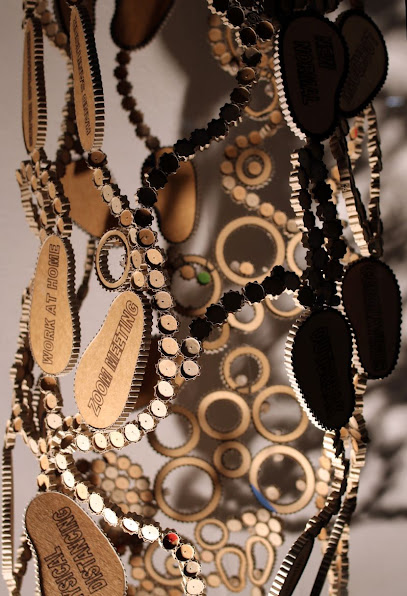
The first thing that Tracy Luff said to me about her work, Passing Through was that it had “ totally changed direction from what it was going to be ” Then after spending 5 days in my studio working on the piece as a flat object she spent another day turning it into the cylinder that is displayed in SLOT. 


Perhaps unintentionally she has illustrated one of the truisms of art making – that art lies in the making of an object not the preconceptions brought to its inception. Art is an inquiry. An inquiry into the self, into the materials that the work is made of, into events that shape our thinking, but above all it is 
simply an inquiry into our thinking. And in this case the artist, Tracy Luff was thinking about Covid 19.

It’s hard to escape the buzzwords of Covid neatly printed on shapes that are woven into the fabric of thepiece. In Tracy’s eyes they introduce an idea of domestic life. They alert the work as our lives have been alerted to the need for vigilance against the threat of Covid. And they are in the shape of feet because Covid has come and will go. In Tracy’s reckoning it will disappear. She continues – “ the piece is for fun, playing with the words and how they match up but they are serious words – the fun didn’t continue and it gets more serious – every action connects with what is happening ”

Watching Tracy’s daily work offered an insight into her art making. The fun of the Covid buzzwords was forgotten as thoughtfully connecting forms and voids, articulated in threaded cardboard discs replaced them as the subject of the work. Irrespective of any tangible meaning that may be attached to the work it is as Tracy commented “ the process of making the work leads to the form it takes ” and further “ the form is dictated by what the material can and can’t do ” Or as the mid 20th century Canadian philosopher Marshall McLuhan put it  – “ the medium is the message.” 

And it could be that the reasoned beauty of Tracy’s artwork supplants any message it may carry about the presence or absence of Covid 19 in our community or thinking.

Tony Twigg


Saturday, 22 January 2022

George Burchett

16 January - 19 February   Mẹ Chồng #1-64 


George Burchett lives in Hanoi, Vietnam, where he was born.

But what are we to make of his art artwork, an offering of Mẹ Chồng  (Vietnamese mother-in-laws)? Is this the first world commodification of a third world stereotype as a kind of P.C. Barbie Doll? Or sentimentality for a place George proudly claims as home – the place he is wedded to?


In my opinion it’s the latter. And from comments that pepper his emails – “Hope the mothers-in-law behave”…”Mothers-in-law can be fickle”…” @ SLOT, the mothers-in-law hop out of the box and onto the shelves in their allocated 8 x 8 formation (They can do a little dance and sing)… At night, they hop off the shelves and spread around town.” – he has invested animate powers in them.


It is crucial to George that his show coincide with Tet, the Vietnamese New Year celebration on February 1 that in Australian history marks the turning point of the Vietnam War, the bloody end of European colonialism in South East Asia.  The  same  colonialism   proposed  a much 
more poetic, albeit equally exploitative, beginning.  The Dutch in Batavia, the Spanish in Manila, the British in Singapore and the French in Hanoi built gracious cities that offered a languid lifestyle far removed from the imperatives of The Hague, Madrid, London and Paris. This is the Hanoi that George is thinking of. He may also recall that his show coincides with the Australia Day celebration on January 26. Each holiday celebrates an engagement with colonialism. It’s coming and it’s going. Through the best of colonialism there is a shared understanding of place, language and history. It is a conduit to global culture. It promotes “cross-cultural vitality”. And perhaps the job of the animate Me Chong George has given us is to whisper to each of us in our sleep that nationalism and it’s mirror, xenophobia have become, like colonialism, a romantic anachronism.


Tony Twigg

Friday, 10 December 2021

Robert Hawkins

5 December - 15 January      I don't understand what you're saying- that's  because you are not listening    


Robert Hawkins’s abstract paintings look like something lifted from the 1920’s.

They speak to the works of Piet Mondrian, Kashmir Malevich, Fritz Glarner and Sophie Taeuber-Arp who along with others invented the idea of geometric abstraction as a kind of Modernism. That is, the art wittily referred to as the isms – stretching from Impressionism to Post Impressionism, to pointillism, Cubism, Constructivism, Futurism, Expressionism, Abstract Expressionism, and on to Conceptualism. It was an era when people expected to find confronting new art styles in galleries of MODERN art. But it’s different now; we expect to find confronting new art technologies in museums of CONTEMPORARY art.

In our contemporary world Robert Hawkins’s paintings offer something that his celebrated and historic antecedents didn’t – humor. It’s playfulness. It’s wonder, partially, why a collection of neatly rendered rectangles, triangles and lines might leave us smiling, even grinning at his glorious abstraction of sheer delight.

It might have something to do with the frames that Robert uses. While his impeccably rendered high art pictures are rigorously consistent, his frames are not, they are chipped low art discards that are incongruously pretensions.

Looking over my notes made as I listened to Robert speak about his paintings, one statement is repeated- “the frame comes first”. This is the reverse of the usual order, where an artwork is finished then a value adding frame is attached. 

In Robert’s case “35 years ago got the idea of making art while playing with framing offcuts - frames come from Reverse Garbage – the frames come first – they are a metaphor - frames because I like being scared of the outside – everything is done with the frame coming first – the frame is the home the work sits in – THE FRAME COMES FIRST – I don’t see it in a kitschy way.”

It is clear that the frame proposes the artwork to Robert. I wonder if our frames of reference leftover from Modernity propose the idea of art in this world that is contemporary with our being? Robert articulates this slightly cynical question by reversing the idea of value adding. In Robert’s art it is the painting that lends value to the frame, or to our outmoded frames of reference with such lucid simplicity that we are left delighting – even chuckling a little as his gently concise works are considered.

Tony Twigg


Wednesday, 9 June 2021

Julie Green

6 June - 4 July     Two drawings 2018/2019  

Julie Green is not big. If you were to meet her you would likely think of her as a petite woman. Who’s eyes begin to sparkle as she describes a life that is anything but small.

From high school in the eastern suburbs to art school with time off in New York to study tap dancing and textile design. The bands, the galleries, on to Europe back to Sydney, finish art school to find a job working for Ray Hughes in his art gallery that simultaneously celebrated artistic endeavor and defied categorization. She went on to work in a bookstore before travelling across Canada’s subarctic tundra with Louis Nowra and Vincent Ward researching Ward’s epic film Map of the Human Heart. Back in Sydney she opened her own gallery, which for her became a meditation on verbal and nonverbal expression. There was an M.A. in art therapy and then in 2000 study at Charlie Sheard’s studio school that “made the bottom fall out of my taste bucket”. Since then she has been working in community art and of course painting and drawing.

Standing in front of Julie’s two drawings, it’s their size and the scale of her marks that is arresting. It’s big and Julie explains, “after 20 years of sero-negative arthritis a new biological drug treatment Humira gave me back my body”. That was a couple of years ago when Trump was in power and Sydney gasped under a blanket of smoke. Julie’s “fucked-up American flag” and heroically defiant tree are swathed in a celebration of mark making that revels in her new found freedom. She explained that she lay on the paper sheets first stretching toe to finger to mark her scale on the drawing. It follows that the arc of her drawn line is the arc of her reach. In this way Julie observes the idea that expressionist art is the physical measure of the artist while a reading of it’s subject is a measure of the observer’s intellect.

It might be a long bow to draw but in an art work there is a marriage between the artist and the viewer. Each arriving at roughly the same spot from different directions. For a moment caught in a single image before departing on divergent paths, each carrying perhaps, for a while at least some echo of their shared meditation. And so it is with Julie’s drawings.

Tony Twigg


Saturday, 15 May 2021

Joe Frost

9 May - 5 June      Miss Universe 2011


Joe Frost's work; Miss Universe 2011 is offered as a compliment to his concurrent exhibition, Riders and Terrains, May 27 – June 19 at Liverpool St Gallery, 243A Liverpool Street, Darlinghurst.

This work, which possibly offers some historical context to Joe’s current show, could more exactly be titled Miss Universal. With her clear hand, her third eye and lumbering breasts she is more mother than candidate in a Miss Universe beauty pageant curated by the likes of Clive Palmer.

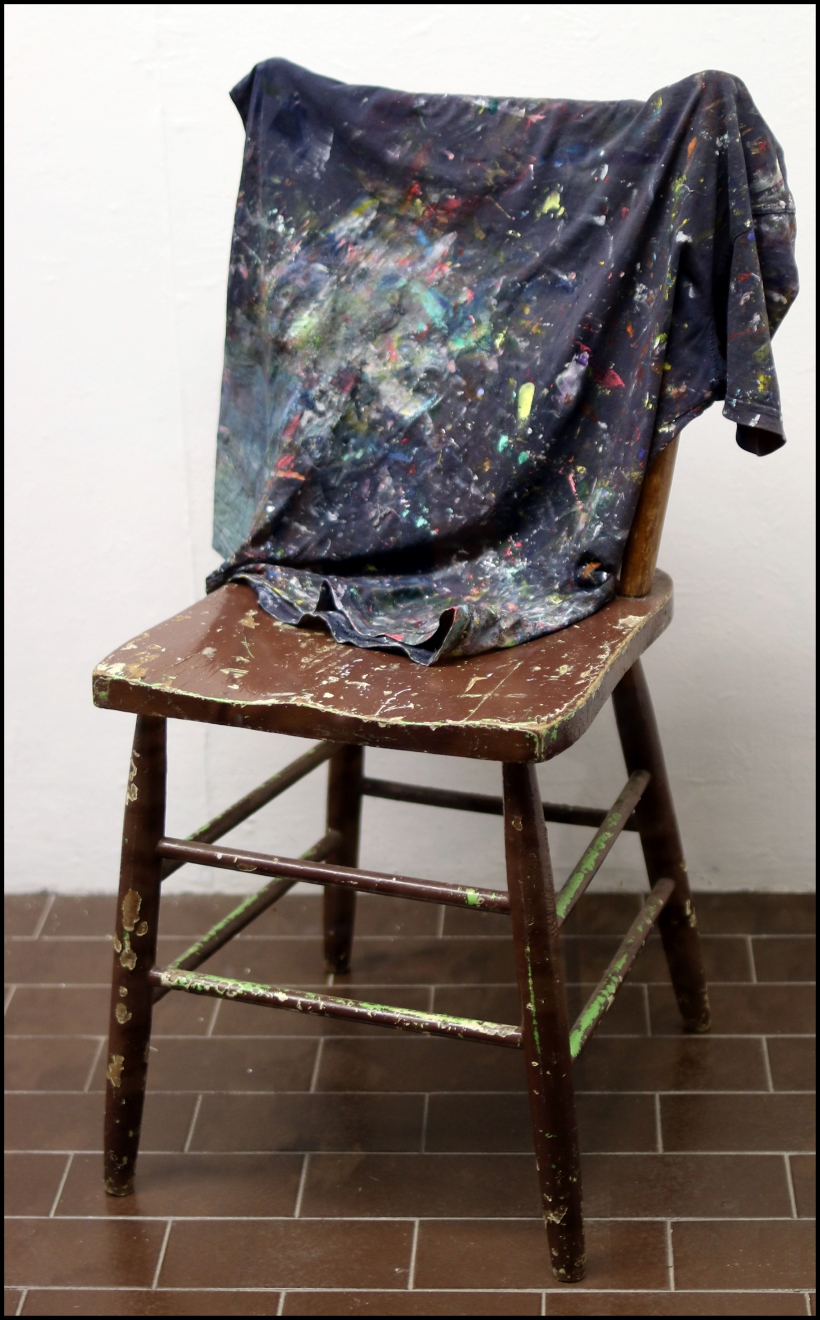
A T-shirt dropped on a chair salutes the masterfully painted figure. It’s the painter’s shirt - left as a parting gesture?  Perhaps as a kind of flourish, like a signature indicating that the act of painting was concluded and that the painting is now finished? Joe commented that he could see something cosmic in a blue smear on the right hand side of the shirt hinting that it may indeed be the universe that gave rise to his loosely assembled “mother”.

With that simple gesture Joe proposes a dichotomy. The apparent spontaneity of his painting belies its deliberate consideration. The fact that his freshly brushed marks hang together with poise and calibration is no accident. It’s the product of long and deliberate manipulation, which sits in stark contrast to the paint-splattered shirt, which is accidental. There is a truth in the accidental application of paint that the painter attempts to emulate. It is free, expressed without inhibition or pretence. The paint is, as they say, permitted to be paint and sit, with our reference to illusion on the surface of the work. This is more than truth, this is the Modernist credo that Joe’s painting ardently aspires to and in my opinion achieves admirably.


The dichotomy Joe indicates can be stretched to the myth of an all-knowing figure born of a Cosmos that is blindly random, as blindly random as the markings on a painter's work shirt. It could be Botticelli’s clam shell giving birth to Joe’s Venus but it isn’t. It’s an artist schooled in the traditions of European religious art making a connection across centuries between the flat iconography of pre-Renaissance painting and the modernist iconography of now.  And to know if this has any bearing on Joe’s current work you would need to visit his show at Liverpool St Gallery, 243A Liverpool Street, Darlinghurst, 27 May – 19 June.

Tony Twigg


Thursday, 11 February 2021

Jayanto Tan

07 February - 06 March      Mantra, I'm a ghost in my own home


Jayanto Tan’s installation, Mantra, I’m a ghost in my own home is SLOT's offering in celebration of Chinese New Year.

For Jayanto New Year is an opportunity for celebration. Indeed the Chinese character, Double Happiness that is both the subject and form of his installation is a celebration of marriage. In this case, perhaps it articulates remnant marriages and marriages yet to be forged between Jayanto and his many homes.

Jayanto is Chinese, although he was born in Indonesia, which casts him as a part of many sub-groups including the Peranakan culture. That is the culture of Chinese immigrants who assimilated the Malay culture and in the process established a uniquely hybrid culture expressed in dress, cuisine and architecture. Now Jayanto is also an Australian, a condition that he has wittily summarised with the invention of the Pandan Lamington, pandan being a Malay food additive that turns everything an optimistic green color. Here in the wide brown land a green lamington offers double happiness for sure. One can be found on the left in Jayanto’s finely sculptured ceramic, albeit rendered in monochromatic white.


Here it has been married with other delicacies into a wreath, a European symbol that simultaneously celebrates birth and death as the unity of eternal life.

In response, the Mantra, I'm a ghost in my own home has been deeply considered. As Jayanto observes “the thousands text of ‘Double Happiness’ could read as my mantra for future happiness…Perhaps there is no future!”


Tony Twigg


Saturday, 12 December 2020

David Helmers

06 December - 02 January 2021     Thin Skinned


David Helmers is a thinker. He is a philosopher and an academic whose enquiry examines the nature of our experience of objects. Some of which are art-objects and some of those are the objects that he makes. They are simultaneously rigid and diaphanous, made from porcelain fused with a synthetic material and so light that they seem to be floating up from the floor into the space of SLOT.


The idea that connects David’s philosophy to his art is “New Materialism”. This he explains is the appreciation of an object’s intrinsic qualities as opposed to those imposed by the social associations it provokes. He illustrated the idea by considering an Yves Saint Laurent spots coat, you might appreciate it because of its fine tailoring or the entry to a particular social set that it entitles.

In art history this dichotomy was reflected in the high modernism of the mid 20th century when art abandoned ideas of illusion and symbology in favour of fact. The experience of these factual art objects was restricted to an experience of their physical properties. For example, 5 square meters of canvas painted blue hung on a wall invites a physical experience. BUT most importantly I think, that physical experience is more or less the same if the piece of canvas is considered art or not art. In this way art expands our appreciation of the physical world and leads to a deeper understand of it.


Since then the nature of art has changed. The need for narrative has injected a sense of meaning-full-ness into an understanding of visual art objects. In various ways we expect to be able to read them, which I think throws up the dichotomy that David is considering. Perceptively so, as we enter a post-Covid19 world where the comparative experience of both the physical realm and the mediated realm has been starkly and broadly examined. Underlining I think, the mission of SOT – to bring a tangible art experience to the street. To offer an art such as David’s that has not been mediated.

Tony Twigg


Tuesday, 11 February 2020

Guy Morgan

02 February - 07 March      The Scorpion's Claw Nebula 
Link to artist's website


Guy Morgan’s painting fits the spectre of the universe into SLOT! This ghost of light is the Scorpion’s Claw Nebula, a large constellation near the center of the Milky Way between Libra and Sagittarus, reminding us that this incomprehensible large astronomic fact fits into our mythology of the zodiac.


At the age of 7 Guy Morgan “discovered he was good at art”. By 18 he was enrolled in one of the world's great art schools, London’s St. Martins School of Art where he gave up painting for graphic art. At 25 he was on a plane heading for Australia when he decided to go into advertising.  After 35 years in the Oz-ad-biz and with worn out eyes he started painting with an eyedropper!

Another version is that at St. Martins School of Art Guy became dissatisfied with the direct connection between his hand and the marks he made. After travelling to Australia he enrolled in the Master of Arts program at the Sydney College of the Arts where he began painting with an eyedropper as a way of distancing himself from mark making– then an image of space evolved. 


Like the nebula and Guy’s biography, his painting invites two readings. One as a pretty good illustration of space that carries all the culturally imbedded information we have about the unknowable space it represents.  The second as a spectre of abstract art. A ghost of High Modernism, Jackson Pollock is a well-known example of artists who distanced themselves from the mark making process. Pollock dribbled and flicked paint from his brush; Morgan used an eyedropper, in both cases inviting gravity into the mark making process with the effect of encouraging the paint to behave as paint.  This paint that represents nothing more than itself sits on a surface that is flat. There is no spatial consideration– a fact that Guy observes in a traditionally modernist manner with a narrow line top and bottom, not a pictorial device but a consequence of the selvedge of the canvas. He reminds us again that canvas is a surface, paint is paint and art is fact, as space itself is fact, both known and unknown.

To offer a pun, Guy's painting is indeed nebulous. He switches effortlessly between the opposed belief systems that govern both his subject and the practice of painting.


-Tony Twigg


Tuesday, 3 December 2019

Sandra Winkworth

24 November - 28 December      I Give To You The Palaces of Montezuma

Link to artist's website


Sandra Winkworth’s piece is made from detritus. But more correctly it is made from litter and imagination. 

Her day begins “with morning walks spotting birds, inspecting home garden fronts and what remains after busy days and nights in the city.” And every Sunday since April those walks have been through Redfern. There was “no planed journey” instead, a “turn from laneway to road side to crossing” into memories that “revisited the streets” of  “skatey/mod/rocknroll days…the 80’s”, ”the gentrified to the old school” collecting “mementos with hawk-eyed intent”. Sandra Winkworth picked up quotations from our streets then glued them into an essay with her imagination that speaks of now, memory and art.

The gems assembled into her opal like offering are grazed by speed. Flattened to perfection by the uncaring pragmatism of progress that surges along our streets. And forsaken, the once essential no longer required, abandoned beside an urgent road carelessly heading towards tomorrows dim recollection. These things are held for a moment in Sandra’s imagination, turned this way or that
then cross-referenced somehow into something with a pang of emotion that feels like places I like a lot, here and art.

So delicately and thoughtfully crafted is this piece that we need to be reminded of the time it spent on the road, as a kind of refugee from our material existence. Now with a revised citizenship of the art world it’s collective emotive power far exceeds the feeling previously accorded to any single item. Is that down to the artist’s hand - her orchestration or is she simply the conductor of an emotive coir?

This is the voice of voices, it's the Palace of Montezuma, Aztec Emperor, “he who is angry in a noble way”, it is a cloud but it is far from a miasma, it is our hope.


- Tony Twigg