Showing posts with label Paintings. Show all posts

Saturday, 20 August 2022

Thomas Kuss & Bahman Kermany

14 August - 17 September      Two Paintings   


The first question for Thomas and Bahman is why show together? The answer is simple, “we're friends, we like talking to each other about ourselves” and “yes, we’ve been friends for a long time.”  Inadvertently their show is a consideration of Islam in Australia.

Bahman’s Iranian mother grew up in an English boarding school. She married his father in Iran and when Bahman was 14 moved on to join her brother in Australia. Bahman’s father wasn’t interested in travelling, which has obliged Bahman to live a life of duality, shuttling between parents  and cultures. He describes Iranian culture and Islam through ancient poetry surviving across the ever-changing political landscape of Persia his preferred name for Iran, which he identifies as a colonial construction. His painting, the smaller of the two presents the image of Zahak, an autocrat drawn from the Shah Name - The book of Kings. An ancient mythological text that tells of the tyrant, a reflection he says of Islamic State’s contemporary brutalisation of Iranian culture.


Thomas’ Chinese mother married his mixed German/Vanuatuan heritage father in Sydney where he was born. He came to Islam through his marriage to Basma, a Sudanese, 3 months ago on the first day of Eid.  Her parents live in the United Arab Emirates within the oasis of Al Ain where his wedding took place, which is the subject of his painting. He is not religious person but went with his father-in-law and the other men of the family to the Mosque where he joined their ritual of prayer. And while praying he described the unusual sensation of his deceased father visiting him to share the joy of his wedding. Perhaps suggesting that in each religion there is an undeclared universality.

Against the clear certainty of Thomas’s journey from Sydney to marry to Basma, for Bahman the key to his journey from Iran to Sydney is doubt. In Iran there is no doubt. For him doubt is the key to free thought. Inadvertently their two paintings encapsulate the polarities of a religious understanding - the idea of maintaining ancient ritual and lore while assimilating it into a modern life. What is without doubt is the sincerity of each artists experience of Islam.

Tony Twigg


Wednesday, 13 July 2022

Suzy Evans

10 July - 13 August      Bengerang    


Suzy Evans is a descendant of the Gomeroi Nation through her maternal grandparents who lived at Bengerang a place near Moree to the north west of Sydney. She describes the dancing figures in her paintings as the representation of “the all of the Gomeroi people”. And her exhibition is SLOT’S belated offering to the celebration of NADOC WEEK, 2022, which we are proud to support.

Suzy is also a neighbour. She lives a few streets away in Waterloo. Coincidently her terraced house is part of a row identified as a heritage item by the City of Sydney Council in their recent rezoning of our area. Inadvertently they point to the fact that an Australia heritage is a faceted condition. Irrespective of our ancestry, indigenous, settler or migrant, in Australia we are part of our countries heritage, described in the Uluru Statement from the Heart of 2017 as stretching “from the creation, according to common law from ”time immemorial”, and according to science more than 60,000 years ago.” Concurrently as Australians we are responsible for and to our heritage that stretches from the beginning to the present and into the future.

In 1967, perhaps belatedly the people of the Commonwealth of Australia voted at a referendum to include Aboriginal and Torres Straits Islanders in their settler society. Soon there will be a corresponding referendum prompted by the Uluru Statement from the Heart that is an invitation from the Indigenous people of Australia to join them in what will become our country.

We must accept this profound invitation. It has proposed a referendum that will recognise the indigenous people of Australia in the constitution and give voice to their heritage in parliament. It behoves us to ask, what does this mean?  And the point is that we don’t know what it means yet. The point is that we have to invent what it means and what it means as Suzy Evans might say - to become the all of the Australian people - to stand at the next beginning of our culture.


Tony Twigg


Friday, 10 December 2021

Robert Hawkins

5 December - 15 January      I don't understand what you're saying- that's  because you are not listening    


Robert Hawkins’s abstract paintings look like something lifted from the 1920’s.

They speak to the works of Piet Mondrian, Kashmir Malevich, Fritz Glarner and Sophie Taeuber-Arp who along with others invented the idea of geometric abstraction as a kind of Modernism. That is, the art wittily referred to as the isms – stretching from Impressionism to Post Impressionism, to pointillism, Cubism, Constructivism, Futurism, Expressionism, Abstract Expressionism, and on to Conceptualism. It was an era when people expected to find confronting new art styles in galleries of MODERN art. But it’s different now; we expect to find confronting new art technologies in museums of CONTEMPORARY art.

In our contemporary world Robert Hawkins’s paintings offer something that his celebrated and historic antecedents didn’t – humor. It’s playfulness. It’s wonder, partially, why a collection of neatly rendered rectangles, triangles and lines might leave us smiling, even grinning at his glorious abstraction of sheer delight.

It might have something to do with the frames that Robert uses. While his impeccably rendered high art pictures are rigorously consistent, his frames are not, they are chipped low art discards that are incongruously pretensions.

Looking over my notes made as I listened to Robert speak about his paintings, one statement is repeated- “the frame comes first”. This is the reverse of the usual order, where an artwork is finished then a value adding frame is attached. 

In Robert’s case “35 years ago got the idea of making art while playing with framing offcuts - frames come from Reverse Garbage – the frames come first – they are a metaphor - frames because I like being scared of the outside – everything is done with the frame coming first – the frame is the home the work sits in – THE FRAME COMES FIRST – I don’t see it in a kitschy way.”

It is clear that the frame proposes the artwork to Robert. I wonder if our frames of reference leftover from Modernity propose the idea of art in this world that is contemporary with our being? Robert articulates this slightly cynical question by reversing the idea of value adding. In Robert’s art it is the painting that lends value to the frame, or to our outmoded frames of reference with such lucid simplicity that we are left delighting – even chuckling a little as his gently concise works are considered.

Tony Twigg


Saturday, 15 May 2021

Joe Frost

9 May - 5 June      Miss Universe 2011


Joe Frost's work; Miss Universe 2011 is offered as a compliment to his concurrent exhibition, Riders and Terrains, May 27 – June 19 at Liverpool St Gallery, 243A Liverpool Street, Darlinghurst.

This work, which possibly offers some historical context to Joe’s current show, could more exactly be titled Miss Universal. With her clear hand, her third eye and lumbering breasts she is more mother than candidate in a Miss Universe beauty pageant curated by the likes of Clive Palmer.

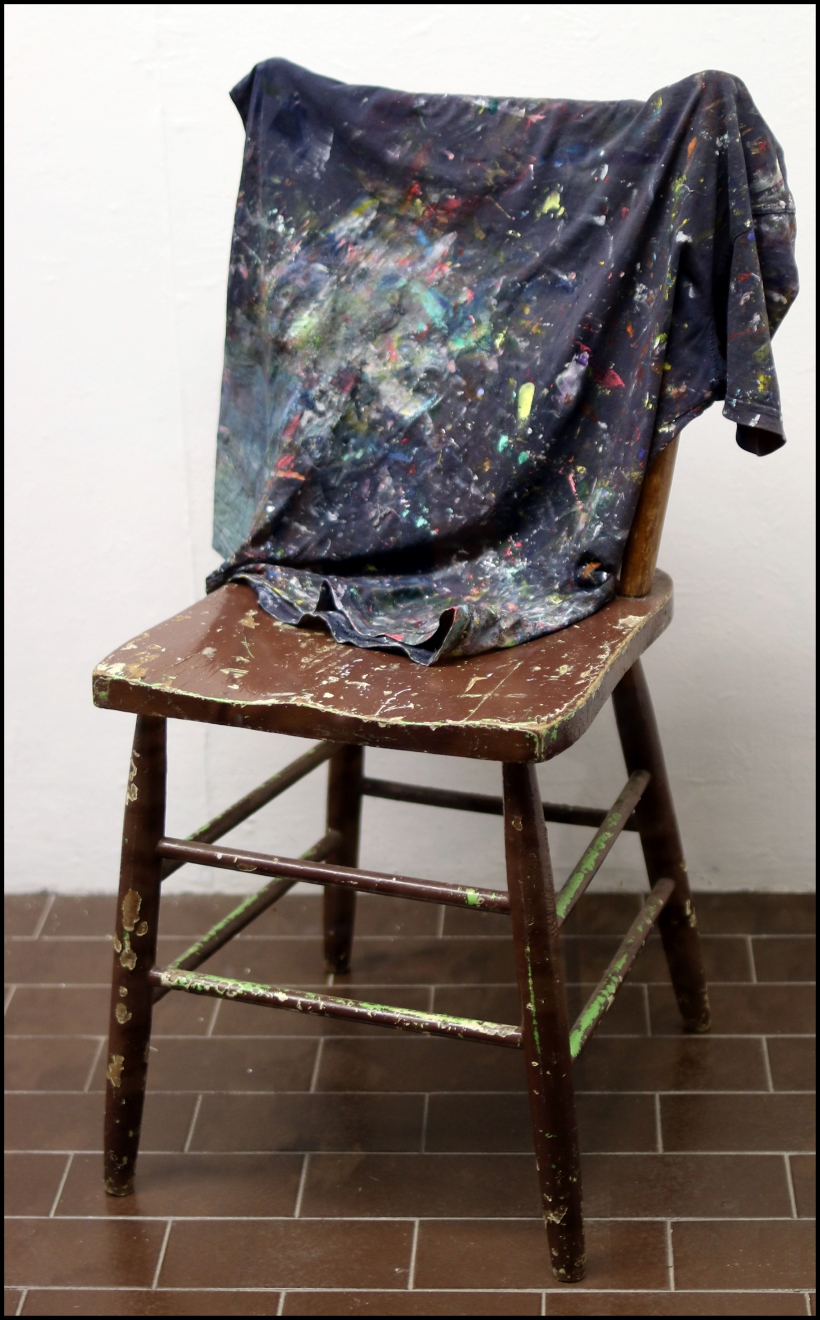
A T-shirt dropped on a chair salutes the masterfully painted figure. It’s the painter’s shirt - left as a parting gesture?  Perhaps as a kind of flourish, like a signature indicating that the act of painting was concluded and that the painting is now finished? Joe commented that he could see something cosmic in a blue smear on the right hand side of the shirt hinting that it may indeed be the universe that gave rise to his loosely assembled “mother”.

With that simple gesture Joe proposes a dichotomy. The apparent spontaneity of his painting belies its deliberate consideration. The fact that his freshly brushed marks hang together with poise and calibration is no accident. It’s the product of long and deliberate manipulation, which sits in stark contrast to the paint-splattered shirt, which is accidental. There is a truth in the accidental application of paint that the painter attempts to emulate. It is free, expressed without inhibition or pretence. The paint is, as they say, permitted to be paint and sit, with our reference to illusion on the surface of the work. This is more than truth, this is the Modernist credo that Joe’s painting ardently aspires to and in my opinion achieves admirably.


The dichotomy Joe indicates can be stretched to the myth of an all-knowing figure born of a Cosmos that is blindly random, as blindly random as the markings on a painter's work shirt. It could be Botticelli’s clam shell giving birth to Joe’s Venus but it isn’t. It’s an artist schooled in the traditions of European religious art making a connection across centuries between the flat iconography of pre-Renaissance painting and the modernist iconography of now.  And to know if this has any bearing on Joe’s current work you would need to visit his show at Liverpool St Gallery, 243A Liverpool Street, Darlinghurst, 27 May – 19 June.

Tony Twigg


Saturday, 1 August 2020

Anya Pesce

27 July - 29 August      Rupture

Link to artist's website


Anya Pesce says her art-work, Rupture,  evokes “the uncertainty and futility we are experiencing during the Covid 19 epidemic.”

She also explains its making process in detail. Since 2015, Rudi, who owns a plastic fabrication shop in Fairfield has welcomed Anya into his factory where she uses a machine that extrudes plexiglas, on this occasion beyond its limit. When the bubble burst, in a single uncontrolled action, the brittle sheet of plexiglas became flesh, with flaying lips, enticingly enclosing an orifice. It’s sexy. Like a sports car, a cocktail bar after dark and all the shiny advertising that preys on the biology of our brains, her art is visceral, with desirability that invites a new category – Pop Abstraction.

In conversation, Anya takes this idea further by describing the way her long education in art, at Meadow Bank TAFE, Charlie Sheard Studio School and the National Art School lead her from painting through installation art to the idea of making as opposed to fabricating, works in a single gestural action. And in that sense this work, Rupture would be the epitome of Anya’s work to date.

Reconciling the idea of spontaneous sexualized exuberance with Covid 19, is of course impossible, they preclude each other. But a meditation on it throws up questions about the nature of content in art-works: The content of a novel for example has little to do with the beauty of the printed page, however appealing it might be. In contrast the content of an abstract painting does not extend beyond an appreciation of its component parts however enticing it might be to impose symbolism on it. Needless to say it is difficult to read any art-work out side of the context of its making, its time and its culture, which unquestionably includes Covid19 at the moment.

-Tony Twigg


Rupture stands as a metaphor for the uncertainty and futility we are experiencing during this COVID-19 pandemic. When words are limited, emotions challenged and uncertainty prevails, a visual expression can instantly evoke a visceral response.

As an artist I obsessively search for new ideas, reimagining forms, shapes and colours to reinvent my work, while consistently using the same material, polymethyl methacrylate - acrylic.

During this COVID-19 pandemic, I embraced the stillness imposed on me during self-isolation, and was able to reflect on my existing practice to take the opportunity and experiment with new ideas and techniques.

To date my works have been made by my hand, manipulating the material with a predictable outcome. Rupture is the outcome of a shift in my practice which involves the use of machinery to determine the work.

In this technique, the material is heated and vacuum-suctioned via a template, which is simultaneously inflated and deflated with air, altering the surface. Mimicking breath, the material is challenged to the point of explosion, resulting in the work’s fractured surface.

Rupture resembles an open wound. In stark contrast to the forms typical of my practice, which are made with an impeccable surface. Here, a gaping hole exists, framed by shards of plastic that burst forward into the viewer’s space.

A tension exists due to the randomness of the fractured material framed by the external geometrical border.

-Anya Pesce


Wednesday, 3 June 2020

Suzy Evans

31 May - 27 June   Open

Link for more information on the Artist


Slot is proud to present Suzy Evans show Open. It coincides first with National Reconciliation Week and secondly with the re-opening of Sydney galleries following the Covid 19 lockdown.

Ruefully Suzy pointed out that the virus demonstrated one thing – how quickly our government could move, “with the stroke of a pen” as she put it, when the issue was survival. Aboriginal Australia hasn’t been so lucky. Now, while the past should never go without acknowledgement the future offers possibilities, of which reconciliation between the first and subsequent peoples of Australia is the most hopeful.

Suzy Evans is a neighbor. The Aboriginal Art Directory notes, “Suzy Evans is an artist working predominantly in painting, sculpture and printmaking. In addition to her work as a painter she produces a range of designer homewares and stationary under the name Modernmurri.” She was born at North Sydney in 1964 and lives mainly between Moree and Sydney. Another directory notes, “She was a finalist in the 2008 Telstra Aboriginal and Torres Strait Islander Art Awards”. Her Heritage Country is Bengerang, NSW, Boomi Garah, NSW, Mungindi, NSW and her language group is Kamilaroi. “Suzy Evans artwork, Night Skies was translated onto banners and light boxes throughout the Sydney during NAIDOC week” and her “inspiration for this painting came from a story told to her by Aunty Rose Fernando from Lightening Ridge. The story goes that the stars in the night sky, known as ‘twinkling stars’ to non-Aboriginal people are known as ‘Laughing Stars’ by Aboriginal people.”


Is it too cheezy to observe that we all live under the same sky? Perhaps. And turning to Suzy’s exquisitely collaged feathers, what is about them that seems precisely Australian? Is it their colour? Perhaps it’s the isolation of the feathers that Suzy describes as a whirling dancers? Or a connection these works on paper seem to make with the bark paintings of northern Australia? Perhaps they hint at a shared heritage, understood more as an emotion than as a narrative, something shared in a way that nationalism isn’t. That would be a reconciliation and one of our societies great achievements.


Tony Twigg


Sunday, 3 May 2020

Tony Twigg

26 April - 31 May      The Absent 5th
This work considers the proposition of playing a work of art as one might play a musical instrument.

In this case the work of art is The absent 5th, by Tony Twigg. A collection of 14 puppet-like wooden forms, similar but not identical, which found a resolution in the form that is exhibited here. 

The proposition of playing this collection of forms called for then to be shuffled, evoking the process of a card game. They became a hand from where elements could be drawn and played. 

Each arrangement adopted by this puppet-like musical instrument that sounds like a hand of cards was recorded in a photograph. A sequence repeated many times that progressed from the given form, through a shuffling that was played out to a remaining single element or nothing. 

Like a single blazing note on a saxophone or a collection of rhythms on a kalimba these hands could be assembled visually into compositions and rendered as a score. For example-

The necessary photographs, 25 in all were printed out and the composition assembled, but would the result be a work of art or would it be a rendition of a work of art? Like the voice of the violin, is this the voice of The absent 5th?


Tony Twigg


Tuesday, 11 February 2020

Guy Morgan

02 February - 07 March      The Scorpion's Claw Nebula 
Link to artist's website


Guy Morgan’s painting fits the spectre of the universe into SLOT! This ghost of light is the Scorpion’s Claw Nebula, a large constellation near the center of the Milky Way between Libra and Sagittarus, reminding us that this incomprehensible large astronomic fact fits into our mythology of the zodiac.


At the age of 7 Guy Morgan “discovered he was good at art”. By 18 he was enrolled in one of the world's great art schools, London’s St. Martins School of Art where he gave up painting for graphic art. At 25 he was on a plane heading for Australia when he decided to go into advertising.  After 35 years in the Oz-ad-biz and with worn out eyes he started painting with an eyedropper!

Another version is that at St. Martins School of Art Guy became dissatisfied with the direct connection between his hand and the marks he made. After travelling to Australia he enrolled in the Master of Arts program at the Sydney College of the Arts where he began painting with an eyedropper as a way of distancing himself from mark making– then an image of space evolved. 


Like the nebula and Guy’s biography, his painting invites two readings. One as a pretty good illustration of space that carries all the culturally imbedded information we have about the unknowable space it represents.  The second as a spectre of abstract art. A ghost of High Modernism, Jackson Pollock is a well-known example of artists who distanced themselves from the mark making process. Pollock dribbled and flicked paint from his brush; Morgan used an eyedropper, in both cases inviting gravity into the mark making process with the effect of encouraging the paint to behave as paint.  This paint that represents nothing more than itself sits on a surface that is flat. There is no spatial consideration– a fact that Guy observes in a traditionally modernist manner with a narrow line top and bottom, not a pictorial device but a consequence of the selvedge of the canvas. He reminds us again that canvas is a surface, paint is paint and art is fact, as space itself is fact, both known and unknown.

To offer a pun, Guy's painting is indeed nebulous. He switches effortlessly between the opposed belief systems that govern both his subject and the practice of painting.


-Tony Twigg


Saturday, 4 May 2019

Anie Nheu

28 April - 01 June      Paean

Link to artist's website


Like many artists, Anie Nheu sees her life reflected in her art. She feels that because her life went one way rather than another her art has permission to go that way as well. As this idea of representation grows it becomes an exercise in mapping that can chart life across generations. It can stretch to accommodate ancestors and locate the artist with in a pantheon of concerns that artists will often describe as their way of making sense of the world.

Anie was born on the road, as she said “moving from place to place with my parents since the civil war in East Timor”. To live a life, as she sees it, in 3 parts, now drawn into a “harmonious whole”. This is the map she has given us. Sketched out on 3 hessian bags stitched together with twine and Anie’s painting that has settled across the surface in a way that does not obscure the origin of her bags - bags, metaphorically that she has lumped since her days in East Timor as an infant.


Of course the work is a painting, symbolic of nothing more or less than itself. It gracefully observes the conventions of abstraction and achieves a beauty that is new to the hessian sacks. But Anie has included some jarring elements. The work is improbably placed on the wall, as if she were to continue working on it rather than display it for our consideration. There is a chair, arbitrarily placed that seems to contradict our preconceptions of scale. And far off to the side is a golden oval that might be something venerated.

The painting that is a map has been given it’s own space; it’s own set of preconditions that is different to ours. It is somewhere else.  Paean, the title, what does it mean? “A song of praise”, “a creative work expressing enthusiastic praise”. Could we think that from somewhere else we are hearing the voice of praise? That from some other time that could be the whole of life so far, comes a song of praise for the here and now? This moment of quiet pleasure, of walking down a street to encounter something that is a lot like an art work, if not the very thing that art is.


-Tony Twigg


Sunday, 11 November 2018

Glenn Locklee

04 November - 08 December      Commute
Link to artist's website


Glenn Locklee is a mysterious artist. His conversations, like his urgently painted pictures are littered with insights and confidences that avoid facts. His pictures, like his urgently delivered conversations craft “snap shots” into deliberate looking abstractions. The mystery of course is how the artist weaves life into art and then weaves art back into life.

These pictures seem to begin with a photograph, a snap shot of an image caught on the run between one place and another that is rendered with the sureness and brevity of reality. The rest of the painting recasts that “snap shot” as a bit player in a formal rendering of the painting as an abstract composition. One section of the picture may be a detail of the “snap shot” another may be a meditation on a surface texture drawn from the detail while another is simply an area of paint applied to the surface of the picture. But the subject of the painting might not be the “snap shot”; it might be the passage of thought from one place to another place that is literally in the painting. This would be the fictional journey from an allusion of reality to a concrete fact, as truthful as the painting is real.

The passage of fact shifting through time is a device in popular culture. Simplistically it’s Post Modern Theory and in art history it is Cubism. This is the idea that a real-truthful-factual picture of something is an amalgamation of various views of it. Modern artists in Paris came up with this portentous idea a century ago. And in a physical and a meta-physical way it accommodates the “bumpy” nature of our universe where light travels, not in straight lines, but in board arching curves that invite the observer to simultaneously observe the observation.

In that sense, these graphically arresting pictures are a bit like comics that are parables of fact.
-Tony Twigg

Saturday, 21 April 2018

Sally Clarke

link to artist's website

8 April - 12 May       The Wonder Quilt, 1998-2018


Sally Clarke with assistance from Lesley Clarke, Brenda Factor, Frances Factor and Trudi Factor, The Wonder Quilt, 1998-2018, Wonder Cloths (for domestic cleaning),150 x 200cm.

 
Sally Clarke’s “Wonder Quilt” could be part of a small but concise exhibition currently on display at the Art Gallery of New South Wales. Three works from the 1970’s and 80’s, each made in a technique usually associated with women’s craft. Ewa Pachucka a Polish artist then living in Sydney crocheted a vast sculptural installation, a Melbourne artist Elizabeth Gower contributed a wall sculpture sewn from diaphanous fabric while the American Miriam Schapiro’s work is a collage of appliqued fabrics. Each work, like Sally’s has one foot in the male orientated tradition of fine art and another in the home spun female craft of sewing and each stakes a claim for the Feminist with in our understanding of art.

In a satiric manner Sally evokes a further analogy with “women’s work” by choosing a domestic cleaning product “Wonder Cloths” as her quilting medium. She further challenges the masculine concept of the author, the so-called auteur by working from within a collective of collaborating artists - Lesley Clarke, Brenda Factor, Frances Factor and Trudi Factor.

This is not a heroic expression of individuality that proposes an alternate reality. It is a subversive conversation that seeks to alter and succeeds in altering our collective understanding of reality. It is the project of Feminism.

- Tony Twigg

Sally Clarke with assistance from Lesley Clarke, Brenda Factor, Frances Factor and Trudi Factor, The Wonder Quilt, 1998-2018, Wonder Cloths (for domestic cleaning), 150 x 200cm.  The wonder quilt exists as both a domestic quilt and geometric painting. Its underlying grid structure is shared by decorative patterning and high modernism. As an organising structure for painting the grid goes back at least to the Renaissance period; as an organising structure for pattern it has existed for thousands of years. Many machines and hands have contributed to the Wonder Quilt. The Wonder Cloths - synthetic and lurid - were manufactured in Taiwan before they travelled the high seas to their distribution point in Sydney. The quilt was made with assistance from a small collective of women family members in my lounge room, an antidote to the model of the lone, tormented genius artist. The quilt was revised in 2018.

About Sally Clarke
Informed by a background in both social sciences and visual arts, Sally Clarke's practice critiques the hierarchical and, in particular, gendered constructions of space and the way spaces, materials, and bodies become defined from one another through the attribution of visual, social and cultural codes. Clarke engages with the way power, and the desire for it, drives such divisions and how this plays out in artistic representations and the cultural contexts from which they emerge. Her works explore how these types of relationships can be re-imagined.


Much of Clarke's work has been preoccupied with material and visual significations of domestic space and all that entails. She explores how low-status materials, forms and representations can take their position among very public and dominant discourses including high modernism, the master narratives of landscape painting and contemporary conceptual art through media such as paint, plasticine and floor vinyl and formats that range from two-dimensional surfaces to installation.

Clarke completed her PhD in Philosophy (Fine Arts) in 2008 and, after fourteen years of working as an academic at the College of Fine Arts UNSW, Sydney, established AirSpace Projects with artist and designer Brenda Factor in 2014. AirSpace Projects formed part of her artistic project until 2017 when it transitioned into its new life as a not-for-profit association. 


- Sally Clarke

Sunday, 10 December 2017

Kathryn Cowen

Link to artist's site

02 December - 6 January      #Otherworlds


Kathryn Cowen. #Otherworlds {in daylight}
2017. Ultraviolet light, posca pen, acrylic, aerosol, and fluorescent paint on board. 1.5x2 m


Kathryn Cowen. #Otherworlds {at dusk}
2017. Ultraviolet light, posca pen, acrylic, aerosol, and fluorescent paint on board. 1.5x2m


This large scale landscape in an amalgam of disparate elements gleaned from a variety of sources. The intention was to create a strange environment that is  inspired by the world and yet presents a portal to an alternate reality; a meeting place of the real and the imagined.

This painting installation is an experiment. For the first time I have incorporated light as a medium. In order to further explore my interest in time, space, place and memory; two versions of the landscape are held within the one painting. The reading of the work will morph from day to night. Once darkness descends, ultraviolet light interacts with the painted work in order to transform the space and reveal an alternate dimension, a world that is “Other”.


#Otherworlds. 2017. Installation view in daylight.


#Otherworlds. 2017. Installation view at dusk.


With thanks to Tony Twigg for providing a venue to bring art to the street and so
generously accommodating this crazy experiment at SLOT.

And to my partner in life and love, Matt Macadam. Without his encouragement, support, lighting and installation skills this project could not have been realised.

Kathryn Cowen
December 2017